About Us

The Indian Ayush market sits at USD 43.3 billion in 2024 and is projected to touch USD 200 billion by 2030. Over the last decade alone, the sector has seen a 15-fold rise, and this is government-tracked growth, not an industry estimate.
If you are thinking about building a beauty brand, the opportunity in Ayurvedic and herbal beauty products is very real. But here is what most founders figure out a little too late.
Before you decide what to build, you need a manufacturer who actually understands the difference between Ayurvedic and herbal. It is because the formulation path, compliance requirements, and ingredient standards are not the same for both.
At Cizy Biocare, that is exactly the conversation we start with every founder who comes to us.
This blog breaks both categories down so you walk into that conversation prepared.
What Are Ayurvedic Beauty Products?

Ayurveda is a 5000-year-old Indian system that treats beauty as an extension of internal wellness, not just a surface fix. Ayurvedic beauty products follow specific ingredient combinations and formulation principles rooted in this system.
In India, they fall under the Ministry of Ayush. So, if you build in this category, it not only means that your brand has a framework to fall back on but also carries a level of credibility that “natural” or “plant-based” simply can’t provide.
And if you are building a brand for wellness-conscious consumers, that distinction is far more important than most people realise.
The Ingredients and the Science Behind Them
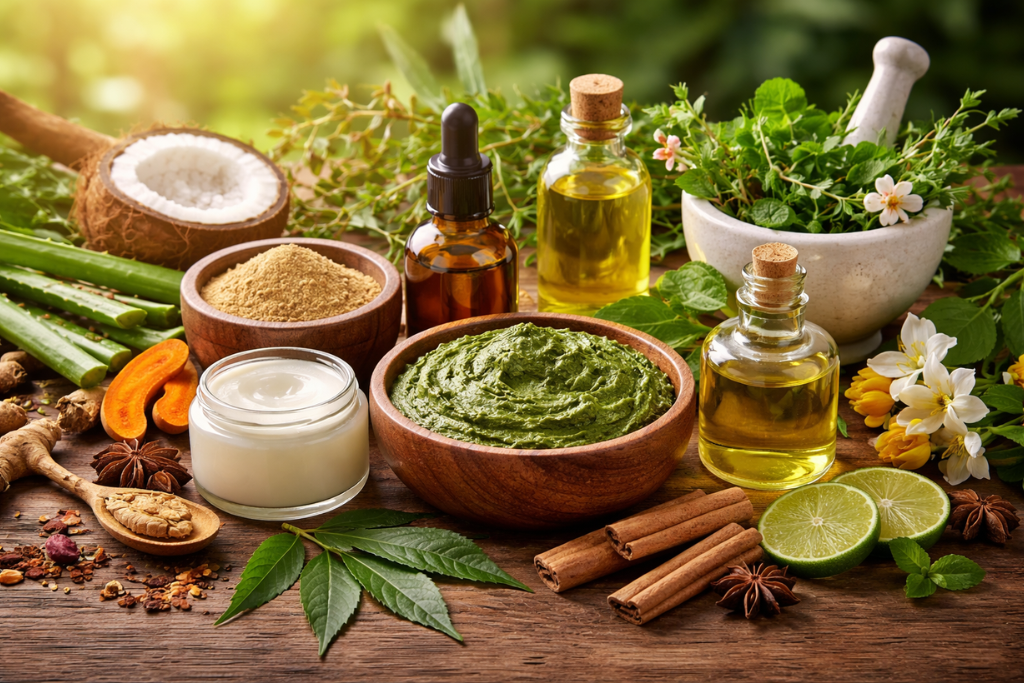
The ingredients of Ayurvedic beauty products are well known. What we need to know is the science behind these ingredients to make these products work effectively.
Neem contains nimbidin and nimbin, two compounds with well-documented antibacterial and antifungal properties. It is a staple in acne care and scalp formulations, not because of tradition alone, but because the clinical backing is solid.
Turmeric gets its power from curcumin, a polyphenol that inhibits inflammatory pathways in the skin. This is what makes it effective in brightening formulations and face packs. The research on curcumin in dermatology is extensive.
Ashwagandha works through withanolides, adaptogenic compounds that help the skin manage stress-induced damage. It is increasingly being used in anti-ageing formulations targeting a very modern problem.
Brahmi contains bacosides that support scalp circulation and strengthen hair follicles at the root, which is why it finds its way into serious hair care and scalp treatment formulations.
Sandalwood carries alpha and beta santalol, compounds responsible for its soothing and brightening properties, long used in Ayurvedic face care for sensitive and dull skin.
Now, here is the part that does not get talked about enough. These ingredients are only as good as the standards set when they were sourced and stored.
We are quite particular about this at Cizy Biocare. We ensure that every raw material is procured and stored in the best of conditions so that nothing loses its potency even before the formulation begins.
When you are evaluating ayurvedic products manufacturers in India, don’t forget to ask this question. It makes a far larger difference to the final product than one would imagine.
Benefits of Ayurvedic Beauty Products
The benefits of building in this category go beyond the product itself. They are:
- Less sensitivity and return rates because the product is gentler
- A holistic philosophy provides your brand with a more interesting story to tell beyond the product benefits
- Ayush certification provides credibility beyond the natural and organic labels
- High and growing trust in this category, especially since the pandemic when wellness has become a priority
- High export potential as there is demand in Southeast Asia, the Middle East, and the West for wellness products
And the best part? Your customers will vouch that the results of using Ayurvedic products last!
What Are Herbal Beauty Products and How Are They Different?
Herbal beauty products are built on the goodness of nature in its most flexible form. Botanical extracts, roots, flowers, essential oils, plant actives, the ingredient palette is wide, and the formulation possibilities are genuinely exciting.
A rosemary shampoo, a green tea toner, a chamomile face wash, the variety you can build in this category is real. The term plant-based is something that consumers across the world can understand and relate to. And the scope is quite broad as well.
At Cizy Biocare, we have our herbal product range that includes balms, creams, massage oils, body polish, and herbal syrups, each containing specific herbs that perform specific functions.
The Ingredients and the Science Behind Them
The science behind herbal beauty products is what differentiates a well-built formula from one that simply sounds good on paper. These are the ingredients at work.
Aloe Vera’s active ingredient is Acemannan, a polysaccharide with intense hydrating and healing properties. It is one of the most researched cosmetic ingredients in the world and can be found in a variety of products from soothing gels to after-sun care for a reason.
Green Tea Extract contains EGCG, one of the most potent antioxidants in cosmetic science. It neutralises free radical damage, which makes it highly effective in anti-ageing and brightening formulations.
Tea Tree Oil contains terpinen-4-ol as its active antimicrobial agent. It has been clinically tested for acne treatment and scalp care, and is now a norm in various herbal beauty products recommended by dermatologists.
Rosemary Extract has ursolic acid and rosmarinic acid, which are known to improve scalp circulation and support hair density, thus a tried-and-tested option for hair growth products.
Chamomile has apigenin and bisabolol, which are known anti-inflammatory agents and skin soothing agents, tried and tested for sensitive skin products.
A good herbal product comes down to how well the active compounds are extracted and kept consistent batch after batch.
Our R&D team at Cizy Biocare handles exactly this. We have an in-house lab and over 100 approved formulations ready, so founders do not have to start from zero.
Benefits of Herbal Beauty Products
Herbal products are a practical category to build your brand in. Here is why:
- You can build a wide range of products without being locked into one system
- Vegan, cruelty-free, paraben-free is easier to accomplish
- It makes it easy to explain the ingredients to young consumers
- Faster to launch, especially in international markets
- Plant-based is universal; no explanation is required
Honestly, it is one of the easier spaces to build a beauty brand in today.
Ayurvedic or Herbal? Let Cizy Biocare Help
This is the question most founders spend too much time thinking about. If you want a brand with deep roots, a great India story, and access to markets where Ayurvedic products are associated with significant consumer loyalty, Ayurvedic is your way to go.
But if you are looking for flexibility in formulation, faster execution, and global reach without category-specific compliance, Herbal gives you that room. Many founders end up building both – an Ayurvedic core range and a herbal range alongside it.”
The truth is that the correct answer depends on your brand vision, market, and your stage in the launch process.
We at Cizy Biocare have the capability to manufacture in both the Ayurvedic and herbal segments from our Ayush, GMP, and FDA-certified facility. Our portfolio includes Ayurvedic face packs, ubtans, and body polish, massage oils, herbal balms and creams, and herbal syrups with over 100 approved formulations and our own R&D team that works with our founders from concept to final product.
Conclusion
Ayurvedic and herbal beauty products are two different routes and have tremendous potential depending on what message your brand wants to convey. Science is on your side, the market is there, and the manufacturing capability is in India.
What is important is that you understand the category, the ingredients, and the ayurvedic products manufacturers in India that can help you build your brand. If these three things fall in line, everything else will fall into place.
FAQs
Q1. What is the difference between Ayurvedic and herbal beauty products?
Ayurvedic products follow the principles of Ayurveda and are regulated by the Ministry of Ayush in India. Herbal products are a broader category where any product using plant-derived ingredients qualifies. All Ayurvedic products are herbal but not all herbal products are Ayurvedic.
Q2. Are Ayurvedic beauty products scientifically proven to work?
Many core ingredients used in Ayurvedic formulations like turmeric, neem, ashwagandha, and sandalwood have been studied clinically. Their active compounds have documented mechanisms of action and the science increasingly supports what traditional practice has known for a long time.
Q3. Which herbal ingredients are most effective for skincare?
Aloe vera, green tea extract, tea tree oil, chamomile, and rosemary are among the most studied and widely used herbal skincare ingredients. Each has specific active compounds responsible for their effects, from hydration and antioxidant activity to antimicrobial and anti-inflammatory properties.
Q4. Can I build a brand that uses both Ayurvedic and herbal products?
Yes, and many successful Indian beauty brands do exactly that. An Ayurvedic core range carries the brand’s depth and legacy while a herbal line gives the flexibility to expand and innovate. Working with a manufacturer who handles both categories makes this much easier from a compliance and consistency standpoint.
Q5. How do I find the right Ayurvedic products manufacturer in India?
Start with Ayush certification, it is non-negotiable for Ayurvedic products. Beyond that, look for in-house R&D capability, ingredient sourcing transparency, and a track record of working with brands at your stage. Experience across both herbal and Ayurvedic categories is a strong indicator that the manufacturer genuinely understands the space.

Cizybiocare
Founder, Cizybiocare
Japarsh Singh draws on decades of expertise in cosmetics and Ayurveda, combining traditional knowledge with modern innovation to deliver ethical, high-quality products for global beauty and wellness brands.


 8 mins read