About Us

The market for herbal and Ayurvedic products in India is not niche. The Indian Ayurveda industry saw revenues worth more than USD 11 billion in 2024 and is expected to grow to USD 35 billion in 2030.
Manufacturers are expanding their portfolios of products, new brands are coming into the herbal sector on a monthly basis, and there is unprecedented demand for compliance manufacturing partners.
But herbal product manufacturing in India operates under a specific regulatory framework that many manufacturers underestimate until it becomes a problem.
AYUSH guidelines govern everything from how a facility is set up to how a product is labeled and what claims it can make. Getting this right is not just about avoiding penalties. It is about building a manufacturing operation that brands trust and regulators approve.
So, if you produce or plan to produce herbal formulations, understanding AYUSH guidelines is where that foundation begins.
Read on!
What is AYUSH and What Does It Govern?
The term AYUSH is an abbreviation that means Ayurveda, Yoga and Naturopathy, Unani, Siddha, and Homeopathy.
AYUSH works as a specialized Ministry in the Government of India, which was formed to standardize the traditional and herbal medicinal practices in the nation.
As a regulatory body, AYUSH touches every part of the supply chain. It governs how herbal products are licensed, manufactured, labeled, stored, and sold across India. The legal backbone behind all of this is the Drugs and Cosmetics Act of 1940, specifically Schedule T, which lays down the GMP requirements that every herbal product manufacturer must meet.
While AYUSH guidelines apply across the entire lifecycle of a herbal product, this article focuses specifically on the manufacturing side, what the guidelines demand from a facility, and what compliance actually looks like on the production floor.
Important AYUSH Guidelines Every Herbal Product Manufacturer Must Know
AYUSH compliance is not a single checkbox. It covers several different areas of manufacturing, and each one carries its own set of requirements.
Below, we have mentioned what manufacturers need to have in place:
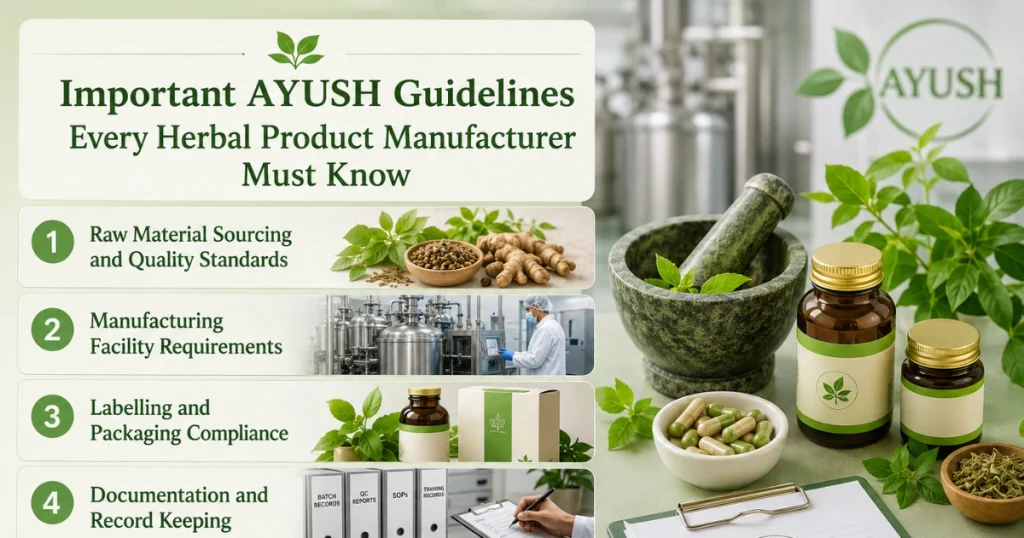
Raw Material Sourcing and Quality Standards
Raw material quality is where AYUSH compliance begins, and it is also where many manufacturers fall short without realizing it. AYUSH guidelines require that every herbal ingredient entering a facility meet specific purity and authenticity standards before it touches a single formula.
This means:
- All raw materials should always have a quality certificate from a reputable supplier
- The botanical identification of the ingredients is essential in confirming their authenticity
- Adulterated, substandard, or improperly stored materials are a direct compliance violation
- All incoming raw materials should be quarantined, tested, and certified before production
This is where traceability becomes essential. For instance, any manufacturer failing to trace back the ingredients to the source lacks documentation and can be easily spotted by AYUSH authorities.
Manufacturing Facility Requirements
A facility producing licensed herbal products under AYUSH must hold AYUSH GMP certification. This is not optional. Operating without it while manufacturing regulated herbal formulations puts both the manufacturer and every brand they supply at legal risk.
Schedule T under the Drugs and Cosmetics Act outlines exactly what a compliant facility looks like. Cosmetic manufacturers moving into herbal product lines need to pay particular attention to:
- Dedicated production areas that prevent cross-contamination between product categories
- Equipment that is cleaned, calibrated, and maintained on a documented schedule
- Controlled environment standards covering temperature, humidity, and air quality
- Qualified personnel in key technical roles, particularly a licensed pharmacist or Ayurvedic practitioner, to oversee the production
The facility itself must reflect the same discipline that GMP demands on the production floor.
Labelling and Packaging Compliance
AYUSH has clear and non-negotiable requirements around how herbal products are labeled. A compliant label is not just about looking good on a shelf. It is a regulatory document that must carry specific information in a specific format.
Every herbal product label must include:
- Complete list of ingredients with scientific names
- Date of manufacturing/expiration along with batch number
- License number for AYUSH manufacturing
- Directions for use
- Caution, if any, to be specified according to the product category
The statements written on packages need special focus. AYUSH controls the statements that a brand or a manufacturer is allowed to make about a particular herbal product. Unauthorized medical claims on a cosmetic or herbal product package are among the most frequent compliance failures that can be easily avoided through adequate knowledge.
Documentation and Record Keeping
Documentation is key to AYUSH compliance. All decisions that are made, all batches that are produced, and all tests that are conducted must be documented in writing. The inspectors don’t just check out the factory. They check out the paperwork.
Manufacturers must maintain:
- Batch manufacture records of all production batches
- Testing and validation records of raw materials
- Equipment cleaning and calibration records
- Training records of personnel in GMP-related activities
- Quality control testing of each finished batch before dispatch
You have to maintain the records for a minimum period as specified under Schedule T and made available during regulatory inspections without delay. Lack of proper recordkeeping is always among the most common causes of nonconformities in manufacturers, despite having all other aspects in order.
The AYUSH GMP Certification Process for Manufacturers
Getting AYUSH GMP certified is a structured process.
Here is how it works in the right sequence:
- Identify which AYUSH schedule applies to your product category. Schedule T covers most herbal and Ayurvedic manufacturing requirements
- Run an internal gap assessment comparing your current facility operations against Schedule T requirements
- Set up documentation systems, hygiene protocols, and quality control processes that meet AYUSH standards
- Train staff across every department on AYUSH GMP-compliant procedures
- Appoint qualified technical personnel, including a licensed pharmacist or Ayurvedic graduate, as required
- Apply to the State Licensing Authority in your state for a facility inspection
- Undergo the formal inspection and address any observations or non-conformities raised
- Receive your AYUSH GMP certificate and maintain it through periodic renewals and internal audits
Most facilities with a reasonable operational baseline can work through this process within six to twelve months with the right preparation and guidance in place.
Why Choosing an AYUSH Certified Manufacturer Matters for Your Brand
When brands develop their herbal or Ayurvedic product range, the partner they collaborate with is what makes the difference in ensuring compliance is a breeze for them. At Cizy Bocare, we know that we cater to such brands every single day.
As AYUSH-certified cosmetic manufacturers in Chandigarh, here is what we bring to every herbal manufacturing partnership:
- All of our formulations adhere to AYUSH GMP standards, from raw material procurement to shipping.
- Our documentation ensures that there will be no issues when compliance is checked.
- We have extensive experience in Ayurveda, herbal products, and other natural products, so brands will not be restricted in their choice of products for development
- Our technical team understands AYUSH regulations in depth, which means the compliance burden does not fall on the brand to manage independently.
A brand collaborating with a duly certified manufacturer gets more than just a product. It gets a company that can make the regulatory compliance process much easier for its brand. Explore our herbal manufacturing solutions and allow us to help you identify the requirements of your product range.
Final Thoughts
AYUSH guidelines exist for a reason. They protect the consumer, maintain the integrity of India’s traditional herbal systems, and ensure that herbal product manufacturing in India meets a standard the market can trust.
For manufacturers, compliance is not a burden to manage. It is a signal to every brand in the market that your facility is built to be relied upon.
Get the compliance right, and everything else, client trust, market access, and long-term growth, becomes significantly easier to build.
Frequently Asked Questions
Q1. Is AYUSH GMP certification mandatory for all herbal product manufacturers in India?
Yes, this requirement is compulsory according to the provisions of Schedule T of the Drugs and Cosmetics Act. Operating without it puts both the manufacturer and every brand they supply at direct legal risk.
Q2. What is the difference between AYUSH GMP certification and ISO 22716?
The ISO 22716 standard applies to cosmetics manufacturing; AYUSH GMP under Schedule T applies to herbs and Ayurvedic products. Manufacturers of both kinds of products should have both certifications.
Q3. How long does it take to get AYUSH GMP certification?
Most facilities complete the process within six to twelve months. The timeline depends on how prepared the facility is before applying to the State Licensing Authority for inspection.
Q4. Can Cizy Biocare help brands manufacture AYUSH-compliant herbal products?
Absolutely. We hold AYUSH GMP certification and have been manufacturing herbal formulations since 1997. We manage everything from raw material authentication to compliant labelling so brands do not navigate compliance alone.
Q5. What claims can a brand legally make on a herbal product label?
Therapeutic or medicinal claims are not permitted on cosmetic category products. Claims must align with what AYUSH approves for that specific product category and license type.
 8 mins read